
 |
 Latest Entry Latest Chapter All Chapters Landmark Entries '97 Trail Journal Search |
 |
 |
 |
 |
|
|
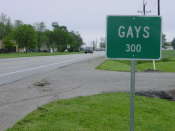
 From Gays to Red Cloud The ceremonial beginning of my journey west would come at the Gateway Arch in St. Louis. But I couldn't help but stop for a prologue on my way to see my friend Edan, a news anchor in Southern Illinois. On my way there I happened upon Gays, Illinois, a town worth visiting even if only for its name, which is proudly painted on its water tower. I drove by one church where it seemed George Bush was getting his way: there were no Gays marriages in progress. "...the more intriguing a two-story outhouse becomes." The two-story outhouse is marked by real government-posted signs, though Gays is so small the outhouse wouldn't be that hard to find. A block from the main road, in the shadow of the Gays watertower, stands the humble yet strangely tall facility. It's neatly painted in white and is surrounded by a small, well-maintained park. A marker proclaims it all has been dedicated to the memory of a Gays native who worked to preserve this unique piece of our history. Sadly, it was locked. I even needed to go. I probably should have asked around town if someone could open it for me. I'm sure I would have wound up in an old woman's living room sipping coffee while waiting for her husband to come home with the key. But I was chicken and headed on south after taking a few pictures. The inner workings of the two-story outhouse will remain a mystery. "Clear across America without seeing anything at all." So after visiting Edan I struck out toward St. Louis by way of the back roads. I got this trip's first glimpse of the Mississippi shortly after turning north on the Great River Road. After getting a little lost I rolled into St. Louis and found my way to the Arch, which was even bigger than I remembered it. There's something really cool about the way the Gateway Arch was built. The structure of the arch is triangular, so you often see only a single side of its metallic skin. Difficult to describe, but it gives it the appearance of a weightless ribbon soaring into the air. Way into the air. It is huge. Look it up on Google, but I bet you could fit the Statue of Liberty... on her pedestal... under the Arch. "The Elvis is Alive Museum and Wholesale Grocer" I continued west into the sunset. A quick meal at a Mexican restaurant in Linn, Missouri and I was back on the road toward Jefferson City. It was getting late and I wanted to stay the night there. I found no roadside motels and nearly broke my "no chain hotels" rule before it even began. I could only find a Fairfield Inn. Fortunately they wanted $70 for a room. I told them I'd get back on the road. I was so determined to find a cheap, non-chain roadside motel I drove all the way to California... Missouri. The next town down highway 50. The California Motel wanted only $28.50 for a basic but clean room. The manager warned me it was nothing fancy. I told him I was sure I'd slept in far worse. I didn't tell him about Shedhi, Ethiopia... or Wadi Halfa, Sudan... or Izamal, Mexico. The next day, May 18, saw two classic road trip destinations. But first was a more somber, topical stop. at the California Motel I'd seen news stories about the 50th anniversay of the Brown v. Board of Education decision. The president was in Topeka to dedicate a new monument at the famous school attended by the lawsuit's plantiff. I found the school easily and was greeted by a very nice park ranger who told me it was the site's first day open to the general public. "More by selective inaction than overt acts of hatred." Within my parents' lifetimes we were within swinging distance of a second civil war. The president was sending Army airborne troops to enforce the Supreme Court decision to end segregation. State governors were calling out the National Guard to defy it. That's unthinkable to me. I can see why people aren't kidding when they say it seemed the country was coming apart. Today, though, is like a photo negative. It's a total no-brainer that segregation was ridiculous. It's so fundamentally accepted that our wildly conservative president probably didn't think twice about proudly appearing at the Topeka site's dedication. Blacks and whites walk the hallways while kids watch multimedia presentations on the history of segregation. Was it mere chance that the fiftieth anniversary of Brown v. Board of Education coincided with a step forward in another civil rights movement, this one still in its infancy? Topeka shared the headlines that day with Massachussets, where America's first legal gay marriages were being performed. It made me wonder if fifty years from now the president may travel without reservation to Massachussets to recall the day we granted another minority equal protection of the law. "The world's largest ball of twine." A sign proudly proclaims Cawker City to be celebrating "50 years of the Ball of Twine." Begun in 1954, he ball weighs many tons and is millions of feet long. I was the ninth visitor today and found someone from Sydney, Australia in the guestbook just a few days ago. This is the ultimate "World's Largest." It's one thing to have the largest specemin of something cool... like a baseball bat or even a shoe. But even a normal-sized ball of twine is kinda quaint... not to mention the world's larget. Thus, Cawker City is a tourist attraction of international reknown. I didn't really mean to find my next destination, but I noticed on the map that I was close to the geographical center of the continental United States, or the "conterminous" United States as my map put it. It's down a small road and is marked with a small monument and flag. What appears to be a defunct motel is next door. A sign directing you to see the "farm that was built in a day" lures the few who venture here. It feels very, very isolated. It was dusk when I visited and utterly quiet. It's a remote part of a remote part of the remote state of Kansas. I understand now why people here feel far removed from the "elites" of the coasts. "I tried to look Republican." I write this at... I'm not kidding... the Green Acres Motel in a room that probably looks the same as it did the day I was born. Dark wood paneling, orange-brown patterned comforters, wood laminate furniture and tile ceilings. But there's A/C and a TV. It may be remote, but this *is* America. You may have heard the term "flyover people." It supposedly marks the difference between the elites who split their time between New York and L.A. and the people whose homes they see only while flying between the two cities. Red Cloud, Nebraska is a true home of the "flyover people." I've never been anywhere in America that's this out-of-the-way, and it's giving me a gnawing sense of unease. Everywhere I go I think, "what do they *do* here?" Even the "city" two hours' drive away seems to offer little in the way of cultural or social opportunities. It's a unique, interesting place and beautiful in its own way, but there's a reason I was born in the East. posted at 8:15pm Local Time |
 Previous Entry