
 |
 Latest Entry Latest Chapter All Chapters Landmark Entries '97 Trail Journal Search |
 |
 |
 |
 |
|
|
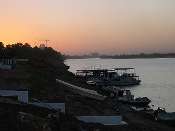
 Africa Hot The Ethiopian guy who'd helped us get from the border into the first Sudanese town ceased to be useful about then. We'd survived the blistering pickup truck ride with thoughts of the "luxury bus" we'd heard about. Supposedly the buses running into the capital were air conditioned. It was debauchery like nothing we'd imagined since South Africa. Air Conditioning! Turns out there's one bus to Khartoum that doesn't have air conditioning, though it still costs the same as the luxury bus. In fact, it's more like the miserable Ethiopian buses. Perhaps this is why our Ethiopian friend put himself, his wife and us on this awful thing. In lieu of air-con there were curtains to try to block out the sun, which were all drawn as we plowed through the desert toward Khartoum. Unfortunately these curtains also blocked out the breeze that might have cooled us a bit. I faired better in the aisle seat. Sandwiched between me and the heat-radiating window, I think Matt nearly passed out. Making it worse was that every other bus that passed us looked very nice and had its windows sealed tight, obviously air conditioned. "I was gonna get my friggin' a/c" Looking down on the city from our balcony it was hard to believe we were in Khartoum. Even the name sounds like a place you shouldn't go. But it didn't feel particularly dangerous, didn't look much different from any other third world capital we'd been in. But it would get quite weird, though. It was Ramadan and we'd yet to realize how much it affects travel in an Islamic country. "From full moon all the way to the next full moon" The most noticeable aspect of Ramadan is that Muslims don't eat, at least not during the day. They get a belly full just before sunrise and then go without food or drink until sunset. Now think about that. Not even water from sunup to sundown'. and you live in the desert where it's like a hundred degrees. Truth be told, some exceptions are made for those who just can't make it through Sudan's sizzling days without a drink. We saw a few people sneaking a swig of water in the heat of the day, but nobody took a bite. A Swiss couple we met said they'd seen a diabetic at a Korean restaurant hidden at a table in the back trying to keep his sugar from dropping off the scale. "Even most food markets were closed." After one night with our forty dollar air conditioning and single-channel TV, we decided to brave something a little less extravagant. I'd found the Ivory Hotel, which had sometime that I think gets called a "swamp cooler" at home. Not quite a/c, just blows air over cool water. We checked in for something like fifteen bucks a night. "The risk of kidnapping seemed a little less remote." This is what was on our minds when we checked into this second hotel. Typical of most any business establishment in this part of the world, the lobby of the hotel was full of idle men. The owner and his buddies, I guess. The TV was blaring but no one watched. Men in white robes sat talking and laughing loudly while smoking those gigantic hookah pipes. If you're looking for danger you'll notice that, while it's not their fault, they all look like they walked right off a most-wanted terrorist poster. And we'd had to show them our passports when we checked in. "Now I know how they felt." At first the gaggle of Arab men didn't bother us. We'd seen the same thing in Dar es Saalam and though nothing of it. But when we'd had time to let our minds imagine all the bad possibilities and realized there was no way to securely lock the room, we started getting a little nervous. Like everyone we underestimate known dangers and overestimate the unknown. Like in a movie when somebody's paranoid and they show lots of point-of-view shots with people doing perfectly normal things that, viewed with paranoia, look threatening. That was us. Leaving the money we'd already paid, we checked out. Setting the record for the shortest-ever hotel stay we headed for the Blue Nile Sailing Club. Not nearly as luxurious as you're probably thinking, this is where Khartoum's rich and famous congregate to smoke and eat (after sunset) on the banks of the Blue Nile river. Inexplicably they also let travelers pitch their tents on the lawn for cheap. Compared to its surroundings, the Club is an oasis of relative cleanliness and quiet. We felt we were as safe as a couple of unarmed white Americans could possibly be. We settled in to wait for the next train north in about five days. During our idle time at the Blue Nile there was quite a funny experience that probably isn't that hilarious if you weren't there. I recount it here mainly for my own memory. "We immediately had a bad feeling." After being led across the "station" area by a kid whose help we enlisted, we were finally told that the ticket office... along with the train station itself? had moved to North Khartoum. That's where had to go. North Khartoum. That would be where the Tomahawk cruise missile Bill Clinton though was aimed at a chemical weapons factory actually blew up a pharmaceutical plant. The CIA may still dispute that, but when you're on a public bus crossing the Nile into the neighborhood it doesn't much matter. It was around eleven in the morning when we arrived at the train station. We found the ticket office closed. "He left," we were told. "Maybe he "About ten minutes into this we realized it was hopeless." This is when we met Ali. He strode authoritatively into the room and asked what we needed. He was wearing the ubiquitous white robe and 1980?s issue plastic frame glasses. Ali spoke excellent English and quickly dispensed of our ferry ticket problems. He also promised that the train ticket office would be open the next day, which is when we returned and again found Ali ready to help. He took our passports and money in hand and went personally to the desk to sort us out. Helpful and knowledgeable we decided he must be the manager of the train station. Asked when we would arrive at Wadi Halfa, the end of the line for the great Sudanese Railway, Ali said "Maybe Monday at... oh... eleven in the night. But the train has no time." Since the train leaves Saturday at eight, that means something like fifty hours. At the time we thought he was hinting that the train doesn't usually leave on time and we should expect a few delays. We would later discover that he was in fact speaking metaphysically and meant that the train exists entirely outside what we conceive as the space-time continuum. Once you board this creaking box of a conveyance every ordinary notion of the passage of time is over. But blissfully unaware of what was awaiting us we were excited to have our tickets sorted and ready to make the final dash to Egypt. Now we just had to pass three more sweltering, food-less Ramadan days in Khartoum. I figured I might blow an hour watching al Jazeera on the TV at the sailing club, but after that it would be mindless boredom in the heat. "They were planning to head west toward Chad and back into West Africa." Just when we thought we were being daring, they told us they were planning to head west toward Chad and back into West Africa and home. They were fighting through the paperwork nightmare that is required for most any trip outside Khartoum unless you're on the train. Registration, travel permit, "intelligence permit," Chadian visa. (Yes, they really say "Chadian.") They'd been here for a week and had days more to go. After sunset one night we went out for dinner in Omdurman, the traditionally Muslim section of Khartoum. Of course everything for a thousand miles is Islamic, but this is the area with all the mosques and the giant souk, or market. Getting there involved yet another minibus, matatu or whatever you want to call it. This one, I think, was actually missing an entire window. In retrospect it would be the last of our entire African trip. What happens at sunset during Ramadan is remarkable. As soon as the sun ducks under the horizon the city comes to life. Restaurants open, people start to fill the streets, groups of men squat in front of their homes for dinner. More than once we were asked to join them. In the souk we found a little stand selling kebabs and tahini. The four of us sat on concrete steps in front of abandoned shops next door and ate amidst piles of garbage as the heat of the day radiated out of the steps. The kebabs were good. "An urgent warning from the State Department." The U.S. Government has received an anonymous warning detailing terrorist threats aimed at American and Western interests in downtown Nairobi, specifically the Hilton Hotel. The timing of the threat is within the next several days. We'd been in and around the Hilton constantly and, as I think I mentioned, even considered the likelihood of it blowing up in front of our eyes. As of this writing the Hilton is still standing, but it was disconcerting nonetheless as we tried to keep our heads down in Khartoum. posted at 8:42am EST |
 Previous Entry